This was the biggest project I ever tackled in my career, running several years from around 1993. It was early days for the industry. CEDIA was just forming, we were grappling with things like the THX standard, and I was figuring out home theater. I had a company called The Audible Difference in Palo Alto, California, with a retail store and custom installation in separate buildings right down the street from each other, and we were doing extremely ambitious work.
So, a client comes along with a very ambitious home. It was an incredible property in the Pacific Heights region of San Francisco, on a steep hill with views spanning from the Golden Gate Bridge across to Alcatraz.
In the bottom level of the house was an indoor lap pool. It was empty, there was no water in it, and the building contractor had put plywood over it so we could safely work there. One day as I was walking across this plywood floor it went Boom, Boom, Boom underfoot. And I thought, whoa, wait a minute. Boom, Boom, Boom… that could be a subwoofer!
I called a very good friend of mine and said, “Brian, Brian, I'm so excited. What can we do with 3,000 cubic feet enclosed by steel reinforced, tapered concrete underneath the floor of a media room?” He said, “I'm getting in my car, I'll be there in an hour.” So, he drives to the job site. He's stomping around. Same thing: Boom, Boom, Boom. Then he said, “I know how to do this.”
That friend was Dr. Brian J. Elliott. Originally from New Zealand, he moved to Palo Alto, California to obtain a PhD in electroacoustics at Stanford University. He's in his 90s now. He's one of the few people still alive who actually worked with Dr. Frederick Terman— the godfather of Silicon Valley— in the electrical engineering department. Dr Terman taught many of the people that went on to create Silicon Valley, and Brian was one of the people in that cohort.
After earning his PhD, Brian became a senior researcher at IBM Research Labs in New York. Then he moved back to Palo Alto to work with his friend Siegfried Linquitz at HP Labs, building #1, where he also got to know Russ Riley really well. Siegfried and Russ were cubicle mates at HP, right across the hall from Dave Packard and Bill Hewlett.
Of course, Linquitz and Riley are the namesake of the Linquitz-Riley crossover network that became fundamental to home theater and subwoofer integration. They all worked it out together, they were all buddies. And one of the things that they worked out was the concept of a full range dipole speaker system. There was no box. The drivers were basically on an acoustically damped panel with an out-of-phase back wave and an in-phase front wave. Where these waves met on the side, they cancelled. As such, there's a whole order of room interactions that go away. They discovered the benefits of this very quickly. Siegfried Linquitz commercialized those concepts with Linquitz Audio. He passed away in 2018 but that company is still very much alive and the dipole speaker concept continues in the form of Linquitz loudspeakers.
So, back to the San Francisco project. Brian and I concocted a solution. I went to the client and asked if he would mind losing the indoor swimming pool space as we’re going to turn it into the media room. He said, “that's outrageous. Do it!” So, we had permission to do this.
Building the World’s Biggest Subwoofer
We designed a new engineered floor system to turn the pool underneath into an enclosure. The temporary plywood floor was replaced with steel beams and steel pan decking, topped with five-inch-thick gypcrete. It was much the same way you’d build the floors separating levels in a parking garage. The result was a very strong enclosure indeed.
Brian got to work on the electroacoustics and calculating the physics behind it. As with any home theater design, many factors had to be considered concurrently – how to best harness the massive, rigid cavity for producing ultra-low, powerful bass, how to manage the transference of bass energy into the room above, and how to manage the room modes in the living space.
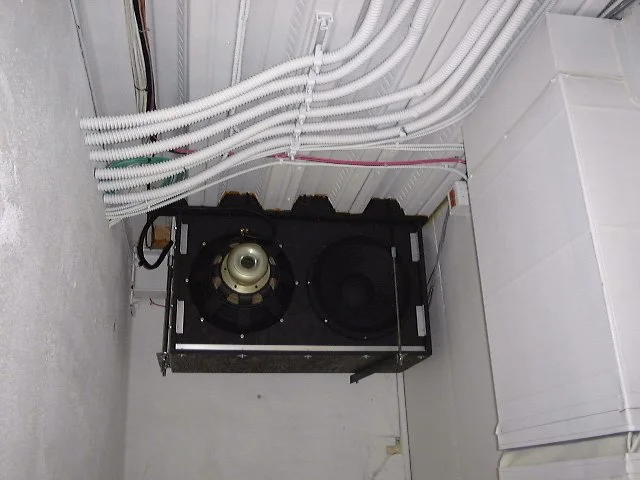
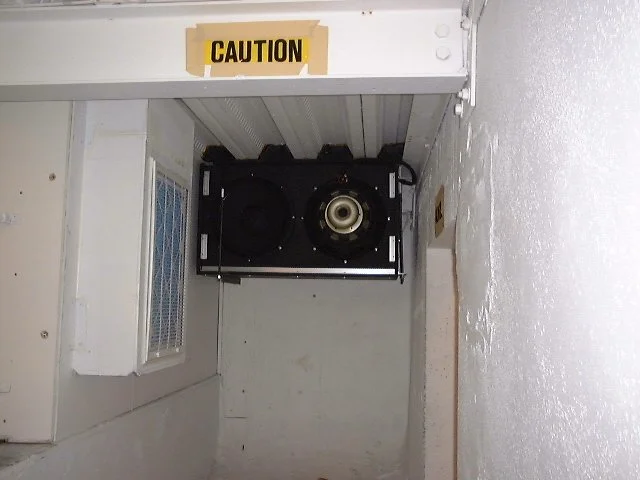
The design he came up with comprised woofer arrays in two sub-enclosures, suspended from the newly-constructed steel pan covering the main pool enclosure. The back wave generated by the woofers loaded into the pool in a way that was constructive. Meanwhile, the front wave faced into the relatively small sub-enclosures, each of which vented up through the floor and into the room above via a 3-foot by 1-foot floor-mounted aluminum grill.
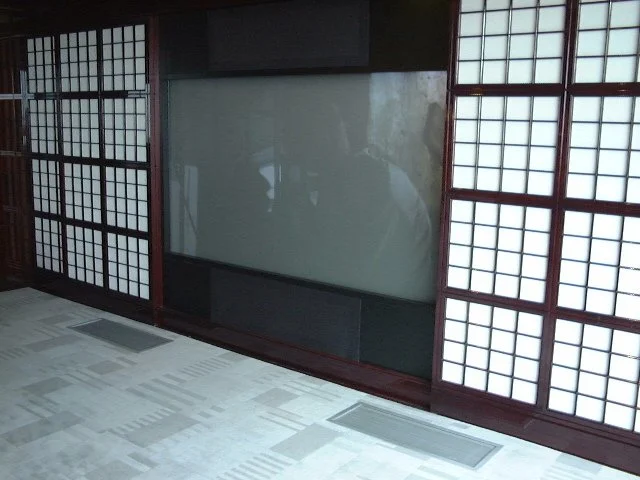
To get enough energy into the room, we used the finest woofers on the planet at the time: an 18-inch unit from AuraSound, model 1808 (later known as NRT18-8). It was very long throw, extremely low distortion, with ventilated air gap in the back. They were designed for use in a large box, and we made the largest! We used 4 woofers, 2 in each sub-enclosure mounted in opposing orientation — one facing forward, the other facing backward. They’re electrically connected out of phase so they mechanically move together in-phase. Doing that cancels a whole order of harmonic distortion. Brian has the math to prove it.
But there’s more. The drivers were elastomerically isolated from the baffle, and the baffle was in turn elastomerically isolated from the box that contained it. And then the whole thing hung with threaded rods from the steel pan deck above, damped to isolate the suspended boxes from the structure. All the resulting energy was acoustic through the air.
“They were designed for use in a large box, and we made the largest!”
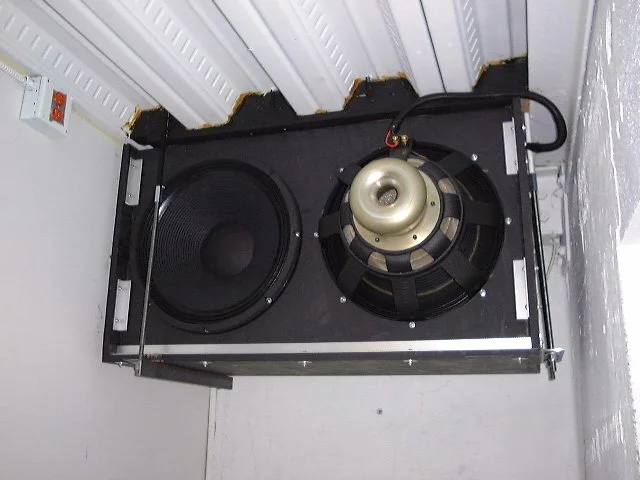
Close up of the sub-enclosure. Select each numbered dot for more info.
(Excuse the low resolution, this was from the VGA digital photo era)
As for room modes in the media room space, Brian did the best he could. Among his equipment from HP Labs, he had access to computers and calculators, and he knew enough about the science of electroacoustics to, within a reasonable range, predict the ideal location for that sound to come from. The whole thing clicked together like a jigsaw puzzle.
We then connected it to a tremendous amount of amplifier power, using a Bryston 4B class AB2 monoblock amplifier for each of the 4 woofers. There was plenty of power, particularly given the system’s remarkable efficiency.
The Video System
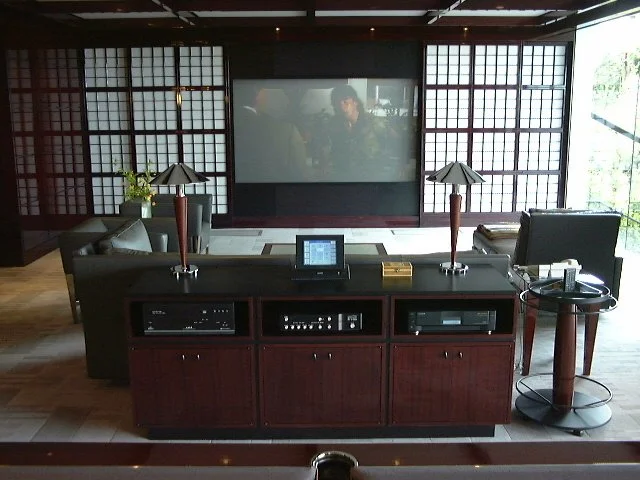
I wanted a very large video screen (for the time). The best way to do this was to mount the projector down inside the swimming pool, inside the subwoofer, with a 2-mirror folded-optic system to a 54 x 96” rear projection screen in the media room. I would have gone with a bigger screen, but I couldn't as the sub-enclosures and vents that Brian had painstakingly designed had to go where they were to the front left and right, limiting the width between them that I had to work with.
Behind the screen we positioned a front surface mirror at an angle aiming down into the hole where the projector was, with another upward-angled mirror right in front of the projector to complete the double bounce to get the light up there onto the rear projection screen. Setback of the projector was around 6 or 8 feet because I had to have enough room behind the screen above for the big mirror.
A regular 3-gun CRT projector—the standard premium option back then—wouldn’t have been bright enough for what we needed. Instead, we opted for the first rear projection application of a Hughes light valve video projector system. It had the Runco brand on it. The picture was blazingly bright for the time. Nobody had ever done this before.
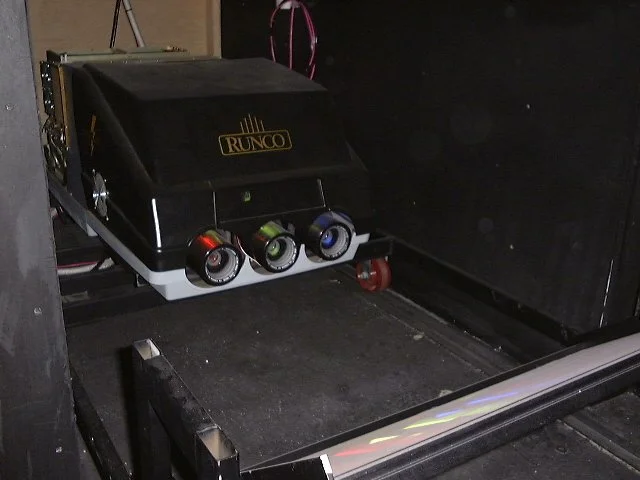
Runco CRT projector with Hughes light valve
We built a soundproof “garage” around the projector and Hughes light bulb to protect them from being torn apart by the immense acoustic energy that was to come. It was built like a fortress too, with a removable face for service access. I had a concrete runway poured by the contractor, on which the projector was mounted on a dolly track so that we could pull it out of its garage, raise its hood, and work on it. Not only were those things heavy, they were very, very fussy; they needed a lot of adjustment. This was a way to pull it out and enable regular service.
Testing, Testing…
This was at the time when the first Jurassic Park movie had come out, so we were using that as a test. The famous T-rex stomp, boom scene… you know, where the puddle ripples.
We're all standing around watching the screen. When that moment came up, we all rose up in the air, what felt like 5 inches. It was probably an inch, but it felt like we had just been thrown into the air by the floor of this room, standing over the cavity of the woofer.
That demonstrated that there was enough energy inside that enclosure to lift steel pan decking and a five-inch thickness of gypcrete. We physically moved. That was single-digit hertz with a lot of power.
Here's another story that indicates the frequency extension of a woofer like this — one time I was inside the pool, basically inside the subwoofer, working on things. There was a hatch in the front right with a ladder going down for access. It was like crawling into a submarine to get down there.
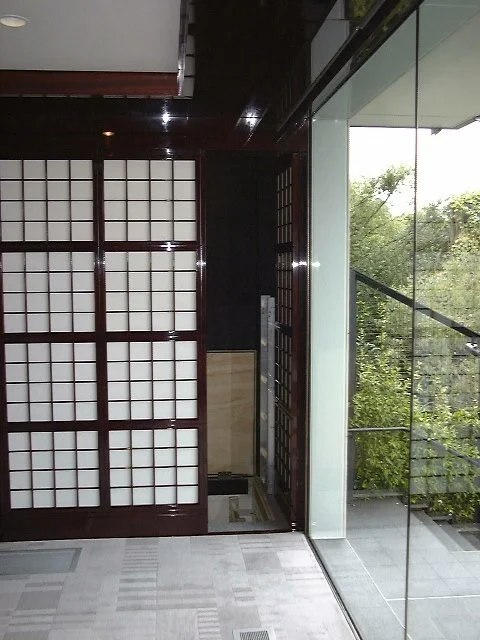
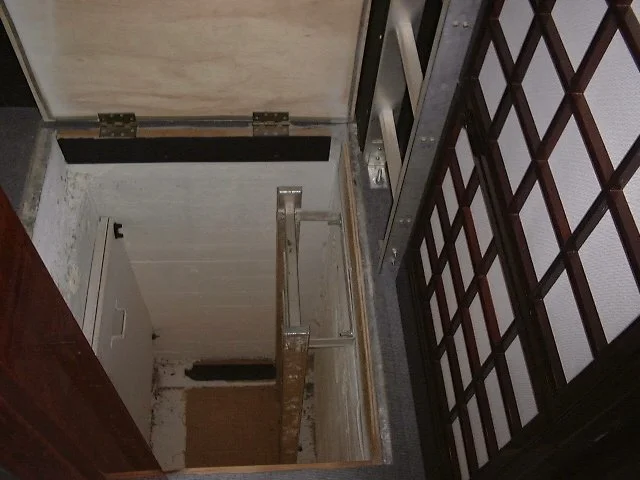
Inside the access hatch with vertical ladder.
And so, I was down inside and Brian was upstairs tuning the system. I'm doing my work, and all of a sudden, I got really sick. Like I was going to vomit, urinate and defecate all at the same time. Feeling extremely claustrophobic, I started hyperventilating. I was really sick. I couldn't get out of that thing fast enough, so I crawled up the ladder and threw myself on the floor.
And Brian is up there just laughing his a** off. I said, “why are you laughing? I'm really sick. I think I'm going to throw up.” He said, “tell me about it. How do you feel?” I replied that I felt like all my muscles just gave up and I'm going to s**t myself. I've never felt like this before.
He said, “yeah, well that was about 4 Hz.”
What he was doing was running an HP oscillator as a source audio signal, and he ran it down to 4 Hz just to see what would happen. He knew I was in there and he started bringing up the level. Of course, it's infrasonic, completely inaudible. It's just pressure. A LOT of it.
And he just kept bringing it up and up, probably to around 110 dB. He knew what he was doing to me. And then I came running up hyperventilating. It turns out that ELF (extremely low frequency) research was done by the Nazis in World War II to torture soldiers on the battlefield with giant woofers. Brian was familiar with that kind of fundamental research.
What this demonstrated was that we’d built an immensely large woofer that could create high SPL in the 2, 3, 4 Hz range. At 9 Hz, it was cruising, and in the 10 to 20 Hz range, very powerful.
The Physics
Brian was able to eliminate orders of audio distortion because of the way the drivers were mounted, the push-pull design of the side-by-side woofers, the physics principles came right out of his dipole research. He then successfully coupled that with a giant cavity with rigid, tapered concrete sides so there was no box distortion.
Inside the main subwoofer/pool cavity, it's essentially free air. It's hard to wrap your head around. I don't know if anyone's attempted this since, because it's such an extreme application of the physics. And it took somebody like Dr. Elliott to pull this off. I couldn't have done it without him. He knew exactly what he was doing and he predicted the performance.
Bottom line, this is an extreme system that was designed based on the principles of math and physics as they apply to electroacoustics. It needed a lot of subtlety in managing the pressure that was built up by the back wave pressure inside the pool, and managing virtually all instances of harmonic and intermodulation distortion down to an absolute minimum with high-capacity drivers that were actually way beyond the need. But that meant it was always cruising at a very comfortable range.
The Main Speakers
The front left and right speakers in the media room were dipoles. Frequency range extended down to the 80Hz crossover. They were open baffle designs encased in an airy, acoustically transparent space with fabric in front of them to harness the benefit of the dipole design, but all you could see in the room was the face of the screen and a beautiful fabric.
The centre speaker was also dipole, stretched under the video screen. However, it didn't have the full frequency range of the left and rights. This back when center and surrounds were typically smaller with limited frequency and dynamic range, compared to the front mains.
The baffles in the main speakers were structurally very complex. Each driver in the baffle was elastomerically isolated from the baffle. That means it's literally hung with a spring. If you push on the driver, it just moves because it's floating on springs. The vibrational energy from the driver doesn't touch the baffle — they’re pure dipoles floating in air.
Brian even created dipole tweeters by having a forward-facing and a rear-facing tweeter. Same for the midranges, which used state-of-the-art componentry.
He made the prototypes in his own home that and have since been improved dramatically over the decades.
To hear that system is a different kind of listening experience. It is the complete absence of the typical distortions you get from box speakers, and a complete absence of the typical distortions you get from the room excitement to the sides of the speaker — that's eliminated because of the dipole configuration. The sound reflection off the ceiling, the floor, the sidewalls, is gone.
In Brian’s own home, when you walk toward the front of the room and you're standing in-line beside his woofers (different to the pool project), you hear very little; all you hear is room sound. You don't hear the speakers because they're very efficient dipoles.
Key Takeaways and Advice
What can we learn from this project?
It takes fundamental engineering capability. Brian was explaining to me that when he got his PhD at Stanford, he had to master the fundamentals of physics, the fundamentals of math. You can't get a PhD in electroacoustics/physics without that.
So, here's a physicist and electrical engineering genius who understood the fundamentals of how sound works in rooms, and he concluded that the dipole was the best way to reproduce sound. When you're listening to music on his personal system, there's a complete absence of distortion. You're just hearing music right on down to the finest little tinkles of a harpsichord. You get lost in it. It becomes a transcendental experience. It's what we're all trying to do as audiophiles.
So, how does that translate to private cinema/home theater designers?
Putting it bluntly, know your s**t. Get down to the fundamentals. Understand the math. When you read RP22, you had better figure out the math if you want to take on a project like I just described. Otherwise, you're just ticking off boxes.
A project like this takes a lot of things coming together. An important one, of course, is getting the client to support the idea. In the case of building the world’s largest subwoofer, the client knew it was a mad science experiment, but fortunately he backed it. He said, yeah, let's go for it. That said, I still had to put a lot of effort into managing his expectations, managing the contractor, and doing all the design documentation, the drawings, the schematics. It was a very complex project, and I take great pride in the work that I did there.
It was years of work. It was my masterpiece. And, you know, it takes a kind of sense of pride to pull something like this off as well. There are lots of times where things did not go well. We could have just thrown up our hands and said, screw it, let's just put in some regular high-end speakers and call it a day. But we thought, no, we're going to push this thing, it'll be the best thing on the planet.
Is anything like that going on today? Are people pushing boundaries? Yes. If you look at the people who are doing the full expression of RP22 Level 4, there's some of that work going on. There are a few instances around the world where it's happening, and there's some amazing engineering going on. Some of those engineers understand the physics and the maths, some of them don't… at least not entirely. But still they're getting incredible results.
In terms of loudspeaker design, you've got companies like coming out of Harman, the Floyd Tool and Paul Barton legacy with JBL and Revel and brands like that. There was some real science going on there at Harman. The JBL speakers are still to this day amazing. By the way, Dr. Floyd Toole and Dr. Brian Elliott were best friends. They kind of grew up together and they admired each other's work. I digress…
Hopefully this story will be inspirational to those few people who will hunker down and do something off the charts outrageous because they know how to do it. It’s a fun ride.